Wednesday, January 22, 2014

Is Less, More?

#Simplicity.
As a boy and young man growing up my father often used the phrase: “less is more”, long before it became part of the popular lexicon.  While the lesson was lost on my youthful ignorance, as I advance in years, the wisdom of the phrase resonates with me more and more.

The question before us in a busy active world is:  can we simplify our lives, and thereby make them more meaningful?  It is tempting to believe that “more is more”, especially when we are building a business, audience, or customer base.  However, is it possible that “less is more” powerful?  In dialogue with Ralph Waldo Emerson, Henry David Thoreau is quoted as saying: “Our life is frittered away by detail. Simplify, simplify, simplify!”  Emerson in reply is reported to have said: “One simplify would have sufficed”.

How can you be more by doing less?

Tuesday, January 21, 2014

How you gonna do it?

 
In an early 1980's song, "Get Down On It", Kool and the Gang asks:

"How you gonna do it if you really won't take a chance
By standing on the wall?"

The refrain is: "Get your back up off the wall."
 
Besides taking me back to an enjoyable time of my youth when dancing was a regular part of most weekends, the song recently reminded me about the benefit of taking #initiative.  I notice that when I am inspired to do a thing, I sometimes hesitate, or get stuck by the little voices that start to tell me all the reasons why I should not do it.  
 
The hesitation, or doubt, seems natural enough.  Perhaps its just a bit of caution, or fear of the unknown.  What I do know is that when I begin a thing and start down a path, the way becomes more clear. It reminds me of the Robert Frost poem, The Road Not Taken:
 
Two roads diverged in a yellow wood, And sorry I could not travel both And be one traveler, long I stood And looked down one as far as I could To where it bent in the undergrowth; Then took the other, as just as fair, And having perhaps the better claim, Because it was grassy and wanted wear; Though as for that the passing there Had worn them really about the same, And both that morning equally lay In leaves no step had trodden black. Oh, I kept the first for another day! Yet knowing how way leads on to way, I doubted if I should ever come back. I shall be telling this with a sigh Somewhere ages and ages hence: Two roads diverged in a wood, and I-- I took the one less traveled by, And that has made all the difference. - See more at: http://www.poets.org/viewmedia.php/prmMID/15717#sthash.KvwzDNfJ.dpuf
Two roads diverged in a yellow wood,
And sorry I could not travel both
And be one traveler, long I stood
And looked down one as far as I could
To where it bent in the undergrowth;

Then took the other, as just as fair,
And having perhaps the better claim,
Because it was grassy and wanted wear;
Though as for that the passing there
Had worn them really about the same,

And both that morning equally lay
In leaves no step had trodden black.
Oh, I kept the first for another day!
Yet knowing how way leads on to way,
I doubted if I should ever come back.

I shall be telling this with a sigh
Somewhere ages and ages hence:
Two roads diverged in a wood, and I—
I took the one less traveled by,
And that has made all the difference.
Two roads diverged in a yellow wood, And sorry I could not travel both And be one traveler, long I stood And looked down one as far as I could To where it bent in the undergrowth; Then took the other, as just as fair, And having perhaps the better claim, Because it was grassy and wanted wear; Though as for that the passing there Had worn them really about the same, And both that morning equally lay In leaves no step had trodden black. Oh, I kept the first for another day! Yet knowing how way leads on to way, I doubted if I should ever come back. I shall be telling this with a sigh Somewhere ages and ages hence: Two roads diverged in a wood, and I-- I took the one less traveled by, And that has made all the difference. - See more at: http://www.poets.org/viewmedia.php/prmMID/15717#sthash.KvwzDNfJ.dpuf

So, "What you gonna do? Do you gonna get down?"


Sunday, January 12, 2014

What is a great book?

Recently, I was recommending to one of my clients a great book entitled, The Seven Habits of Highly Effective People by Stephen Covey. Now, this client is a particularly discerning individual, and she challenged me as to whether or not the Seven Habits is truly a great book.  I said it was, according to a definition articulated by J. Rufus Fears (the late, great historian, scholar, teacher) which I am most fond.  According to Professor Fears, a great book has the following three essential qualities: • Great theme. A great book is concerned with themes and issues of enduring importance.
• Noble language. Great books are written in noble language, language that elevates the soul and ennobles the mind. It is not the specific language, say Latin or English, that is noble. Any language can be used in such way that it conveys ideas and emotions powerfully and memorably.
• Universality. A great book is “a possession for all time” (Thucydides). It speaks across the ages, reaching the hearts and minds of men and women far removed in time and space from the era and circumstances in which it was composed. Thus, a great book summarizes the enduring values and ideas of a great age and gives them as a legacy to generations to come.
Also for Fears, what ultimately makes a great book is its ability to speak to each of as individuals.  I also find this to be true.   As we read a great book many times at various stages of our lives, it should provide guidance and personal wisdom to help us lead virtuous lives.By these measures, I believe that The Seven Habits does qualify as a "great book".  I can recommend it without reservation.  I hope it will speak to you, as it has to me.      

Monday, January 6, 2014

The Best Book on Professional Selling and Corporate Relations

Between Christmas and New Year's I listened to an audiobook, The Joshua Principle, which came recommended to me.  I can say without hesitation that it is the best book I have ever read on the topic of complex and strategic B-to-B professional selling.  For those serving in University Corporate Relations roles, this is a MUST READ.  Here's the synopsis:

Joshua Peters is a salesman in crisis – after losing a key deal his boss threatens him with the sack and he has doubts concerning his choice of career. His father is a sales veteran who progressed all the way to CEO but with their relationship at an all time low he struggles to help. Then a mentor’s invitation from the other side of the world powerfully transforms everything as Joshua’s mentor sets him on the path to discovering leadership secrets of strategic selling. He applies the principles to the biggest and most complex deal of his life and his journey culminates with a powerful meeting that finally reveals The Joshua Principle.


In the book the author (Tony Hughes) outlines the RSVPselling™ approach as follows:

Relationships: Are you selling at the right level, and so you have positive relationships with the key people? 

Strategy: Do you have an effective strategy for managing the relationships, and do you understand the power-base?
 
Value: Are you uniquely creating compelling business value?

Process: Are you aligned with the buyer and do you truly understand the customer’s process for evaluation, selection, and approval. 

For those of you involved in the profession of complex B-to-B sales (strategic large accounts) or University Corporate Relations, I heartily recommend this book without reservation.  

Buy it.  Read it. Read it again.  Then go implement!
 

Tuesday, December 24, 2013

The Sweetness of Life

In the 2003 film Elf, Will Ferrel exclaims that for elves there are four main food groups: Candy, Candy Canes, Candy Corn, and Syrup.  The saying is a comical reference to the USDA's recommended "Basic Four": 1) Vegetables/Fruits, 2) Milk, 3) Meat, 4) Cereals/Breads.  As the holidays approach, my children are fond of quoting this expression, since they would prefer to avoid the USDA's Four in favor of Elf's Four.  Who wouldn't?

In the professional realm, it's often easy to loose sight of the sweetness of those with whom we interact.  We are tempted to regularly serve up large portions of spinach so that our teams and organizations can stay strong.  Now, a side of spinach from time-to-time with the meal is fine thing (preferably sauteed in extra virgin olive oil and fresh garlic, of course).  Man does not live by spinach alone!  Except maybe in the comic strips.

Savoring sweets over the holidays, whether they be fine Belgian chocolates, the company of loved ones, or your colleagues at work is a fine way of reflecting on the gifts we've received over the course of the past year.  

So, go ahead and pour some syrup on that spaghetti.

Friday, December 13, 2013

Uncage Your Heart


In the 1975 horror/suspense film Jaws, an unlikely trio of men which include a drunk ship captain (Quint-played by Robert Shaw), an elected local police chief who cannot swim ((Brody-played by Roy Scheider) , and a smart-aleky young oceanographer (Hooper-played by Richard Dreyfus) prepare to go to sea in search of a great white shark that has been terrorizing a seaside community.  As Hooper loads his gear onboard, Quint queries:
Quint: What d'ya have there - a portable shower or a monkey cage?
Hooper: Anti-Shark cage.
Quint: Anti-shark cage. You go inside the cage?
[Hooper nods]
Quint: Cage goes in the water, you go in the water. Shark's in the water. Our shark.

Quint [singing]: Farewell and adieu toyou, fair Spanish ladies. Farewell and adieu, you ladies of Spain. For we'vereceived orders for to sail back to Boston. And so nevermore shall we see youagain. 
I relay this scene in Jaws as metaphor to illustrate how we tend cage our own hearts in order to protect ourselves from the sharks of day-to-day life.  Leaders can be (and often are) especially tempted to close off their compassion out of fear of being devoured in the sea of life.
As a leader, how are you caging your heart?

Wednesday, December 4, 2013

The Wonderful Wizard of Leadership

Lions, and tigers, and bears.  Oh, my!

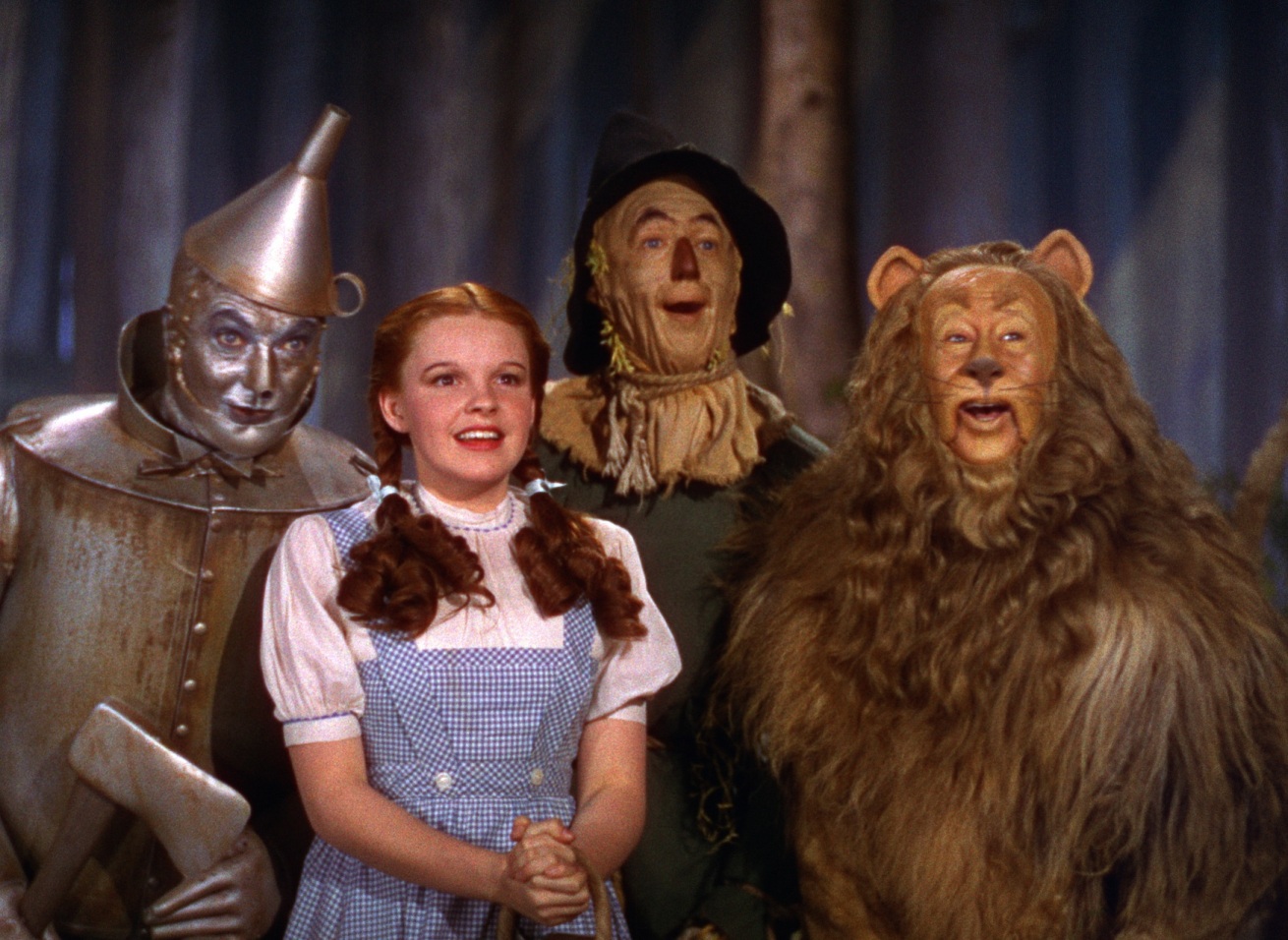
In Frank Baum's 1900 Wonderful Wizard of Oz, our heroine, Dorothy, is swept up by a fierce tornado and later finds herself deposited in the land of Oz, far from her family and home in Kansas.  In order to find her way home, Dorothy is advised to seek counsel from the great Wizard of Oz, who is located in the Emerald City which a long journey down the yellow brick road.  Along the way, Dorothy meets three traveling companions who agree to accompany her: a Scare Crow, a Tin Man, and a Lion.  Each hopes that the Wizard will be able to grant them something they seem to lack: Dorothy-her home, the Scare Crow-a brain, the Tin Man-a heart, and the Lion-courage.  Together, they encounter many trials along their journey, including a challenge by the Wizard to return to him with the broom stick of the evil and Wicked Witch of the West.
This fantastic children's novel may serve as an allegory for leadership.  Like Dorothy, many of us often find ourselves caught up in the storm of our circumstances, and deposited in uncertain territory, seeking the proverbial "way home".  Along the way, we need to access the wisdom (brains), compassion (heart), and courage to resist evil, do the right thing(s), and stay on the path, or "yellow brick road".  And, as with Dorothy, it can be a great adventure filled with trial and tribulation.

At the end of "Oz", the Scarecrow gets his brain, the Tin Man his heart, the Lion his courage, and Dorothy her home.  Upon closer examination, perhaps we notice that each character had these all along.  Or, better still, shall we say that we notice that Dorothy possessed these virtues, and the journey served to strengthened them.

As a leader, what do you notice about your own wisdom, heart, and courage?