Friday, March 28, 2014

This Requires Total Concentration

#Focus
  
"This requires total concentration” (Bruce Lee paraphrase)


Martial artists can focus their mental attention and bodily energy to apply physical forces that astonish most other mortals because the latter cannot see beyond the distractions of their own busy, active minds.


Today, the advent of electronic media and the internet have enabled many distractions that seem appealing at first, yet enslave us in the end.


Text message.  Email.  Phone call.  Tweet.  Pandora.  ipod.  Video game.  Facebook.  Pinterest. Netflix.  Hulu.


Now, where was I? Oh, yes.  Focus.


Fox News.  CNBC.  Politico.  CNN.  Talk radio.  The New York Times.  The Wall Street Journal. Bloomberg.  Reuters.  

What was I doing?  Oh yes, writing a blogpost.

Napoleon Hill in his 17 Principles of Success described a quality he called “Controlled Attention” as the ability “to focus the powers of [the] mind upon the attainment of a definite objective and to keep it so directed at will.”  If one is often distracted, bouncing from activity to activity like a pinball on steroids, how can one achieve or accomplish anything worthwhile?  “Multi-tasking” is an oxymoron!

So, what can we do when we are either assaulted or tempted by the barrage of today’s electronic distractions? I do have a few simple recommendations:

1) Cancel your cable/satellite TV service.  Throw out all radios, ipods, gaming consoles.
2) Read only one literate newspaper each day.
3) When with people, place your cell/smart phone in “airplane” mode, and be fully present for the people you are with.
4) If you must check and respond to email, do so only 3 times each day (morning, around lunchtime, and late-afternoon).
5) Rise early and meditate each day.

I recognize that what I am suggesting here is a radical departure from the way many individuals act these days.  Who among you has the courage to reclaim your focus?

Sunday, March 16, 2014

Fear Is The Mind-Killer


“I must not fear. Fear is the mind-killer. Fear is the little-death that brings total obliteration. I will face my fear. I will permit it to pass over me and through me. And when it has gone past I will turn the inner eye to see its path. Where the fear has gone there will be nothing. Only I will remain.”--Frank Herbert, Dune.

This is the best and most concise description I have ever come across describing the afflictive emotion or "little-death" that often confuses us and causes uncertainty/anxiety/paralysis. Worse yet, fear can cause false action.

Also wrapped up in this pithy little diddy penned by Frank Herbert and uttered by Paul Atraeides in Dune is the suggestion as to how to cope with fear: recognize it, then let it pass.  Easier said than done.  However, is not freedom worth the effort?

Thursday, March 13, 2014

Gang Plank or Diving Board?

During the course of our lives we are often faced with transitions and we are forced to choose. Some examples include:

The stock market goes down precipitously; do you buy, or sell?  You've been dating a beautiful person for two years; do you propose marriage, or break up?  Your company offers you a promotion that includes relocation; do take the assignment, or stay put?  Your friend invites you to participate in a business venture with him; do you accept the invitation, or decline?  Another friend invites you to climb a mountain in the spring.  Do you join her, or not?  Your beautiful companion (whom you did marry) wants to start having children.  Do you go for it now, or wait?


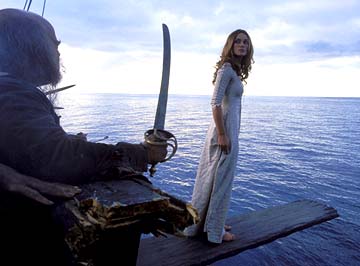
I could go on and on.  It's as if we are often faced with walking out onto a precipice overlooking water.  It can sometimes feel like a diving board that we voluntarily climb upon to execute a Triple Lindy into a warm pool of water.  At other times it can feel as if you've been abducted by pirates, and you are being forced at the point of a sword to jump into shark infested waters.

Right now, I, and about 8 of my Co-Active colleagues are facing a similar transition.  We  just completed our 25 week certification program, taken our written exam, had our final call with our pod leader, and are each facing an oral exam in the coming months.  During life transitions like these it can be helpful to access our intuition in order to discern if we're "walking the plank" or doing the "triple lindy"


When we tune into our intuition it’s like activating our extra-sensory perception. We FEEL if the situation is right for us.  We notice what our body tells us. 

THIS IS NOT STINK'IN THINK'IN!  

We access our clear-knowing of what is right for us.  It is only when we trust the images that we perceive in our mind’s eye that we can see the right path.  If you're intuition has been beaten out of you by the industrial education complex, then working with a good Co-Active coach may help you regain your insight.

So, my friends, what's it going to be: "Gang Plank or Diving Board"


Monday, March 3, 2014

Going The Extra Mile

Napoleon Hill spent most of his life studying the most successful entrepreneurs in American history. He analyzed men like Ford, Edison and Carnegie at length. He concluded that success followed predictable and distinct patterns of behavior. He suggested that all men and women have similar options open to them. He argued that great success and achievement were available to any and all who would choose to follow certain requirements which he spelled out in his many books.

One behavior that Hill identified and articulated as among the most important principles of success in all walks of life and in all occupations is a willingness to "Go The Extra Mile "; which means the rendering of more and better service than that for which one is paid, and giving it in a positive mental attitude.  According to Hill, this habit which he observed in all the successful men that he studied tended to make them indispensable.  It enabled them to profit by the law of contrast since the majority of people do not practice the habit. It tended to help them develop a keen, alert imagination because it is a habit which inspires one continuously to seek new and better ways of rendering service. It develops the important quality of personal initiative.

Why go the extra mile?  Why go out of your way for others?  Besides the great feeling you get in knowing you have helped another in need, the main reason to go the extra mile is that if follows the universal law of sowing and reaping.  By this law we know that we cannot get something for nothing.  In an expression of modern physics the law of sowing and reaping is described by the second law of thermodynamics which precludes the existence of perpetual motion machines.  Energy must be put into the system!  Expressed in another practical way, only a fool sits in front of a fireplace without wood and demands heat.  The wise man (or one with common sense) collects, chops, and hauls the wood to the fireplace and lights it to enjoy the warmth it delivers. 

In today’s society it is sometimes difficult to see why we should go the extra mile especially when our media promulgates the culture of “instant gratification”.  The benefits of going the extra mile are not often immediately obvious or recognizable, however, with patience and faith, the positive results will be revealed.  Going the extra mile will bring out positive emotions in others you help and provide service for, allowing them to both remember you and feel good about you. 

Friday, February 28, 2014

Cherry Pie (a al mode)

You're out to dinner together.  You like ice cream, your partner likes cherry pie. It can be as simple as that.  Then the busy, active, judgement mind takes over.  [Voice1 in the head]: "How could he possibly like vanilla ice cream?  Yuk!  I hate ice cream." [and Voice2]:  "What an idiot! Goopy cherry pie?  Really?"

And thus is sown the seed for conflict.  Worse yet, some folks are deeply uncomfortable about discussing the difference of opinion, or disagreement for fear that they might offend the other person, injure the relationship, or otherwise create an unpleasant circumstance.  In the workplace, this avoidance of conflict on teams can often lead to sub-optimal solutions, inertia--or, worse yet--resentment and brooding.  Imagine if the ice cream and cherry pie couple above dared to try pie a la mode?

The best work in this area is described by Pat Lencioni in his best-selling book: "The Five Dysfunctions of a Team".  For anyone who is striving to develop a well-functioning and high performing team, I strongly recommend that you read the Five Dysfunctions.  You and your team will never be the same.  Enjoy the journey.

Monday, February 24, 2014

To Work or Not To Work [With Someone]...

 
That is the question!

Whether it is nobler in the mind to suffer
Someone thrust upon you by outrageous fortune, 
Or to take a stand for who you want,
And by doing so, to live, to thrive, to choose.

In a free society it is still possible to choose with whom we work, and with whom we do not. Oh, I hear the raucous chorus: "Feldercarb!  I must work with so and so.  That's my job.  I can't say no..."

Well, to test the assertion that "I must", I suggest that those in the chorus ask Byron Katie's Four Questions: 

1) Is it true?
2) Can you absolutely know that it's true?
3) How do you react and what happens when you believe that thought?
4) Who would you be without that thought?


In my role as a professional coach, I am free to choose with whom I work, and with whom I do not.  It's among the most beautiful and enjoyable aspects of being a coach.  And, as my coaching practice develops, I am becoming more aware of the folks whom I inspire, and who inspire me in a truly Co-Active way.  

My clients are:

- Calm.
- Gritty.
- Motivated.
- Dependable.
- Entrepreneurial.
- Open to change.
- Straightforward and direct.
- Deeply appreciative of coaching.
- Truly nice, pleasant, and friendly folks.

What they bring to a coaching alliance is:

- Trust.
- Courage.
- An open heart.
- Fun and playfulness.
- A positive mental attitude. 
- Willingness to experiment, fail, and learn.
- Compassion for themselves and their coach.
- A burning desire to advance and transform their lives.

So, with whom do YOU truly want to work? That is the question.


Tuesday, February 18, 2014

Who's Your Hero?

Recently, Ron Renaud asked a group of folks gathered at a public event in New York City a question about who they respected as modern-day heroes and heroines.  The audience came forth with many fine examples including Mahatma Gandhi, Martin Luther King, Aung San Suu Kyi and Nelson Mandela.   
 

As I pondered Ron's question, I was brought back to my childhood where we used to play a game around the kitchen table called: "who's your hero".  Then, as now,  my answer to that question is without hesitation my father, Nino Langiulli.


In modern society, the discussion of heroes is verboten.  It would appear that heroes are to be treated as mythical relics of ancient history, not even to be discussed nor debated in Classic Departments of great Universities except as literary objects to be deconstructed.  The very idea that a man (or woman) can in the face of grave danger or serious adversity display courage and the will for self sacrifice for some greater good is considered passe by our modern culture.  And I dare say that the notion that a grown man's father can be admired by his son as a hero would be viewed in many circles as quaint, if not derided as peculiar.

I write this post not only as a tribute to my father, but also to recognize all those current heroes and heroines who martial the moral excellence necessary to live virtuous lives in troubling times.  In my father's case, those virtues include (to name just a few):

-Patience (as a husband, father and teacher)
-Courage (to face life in his middle age after the suicide of his younger daughter, and withstand the scourge of systemic cancer, heart disease, and stroke in his later years)
-Wisdom (to use his knowledge in the service of right action, and apply good 'ol common sense)
-Frugality (in his prudent use of all resources)

The ancient Greeks understood that mythical heroes were important archetypes to be emulated for the fortification of citizens in the service of a free society.  Modern society is no less in need of such archetypes.

So, who's your hero?